Straw Dogs (1971)
Thank you.
Thank you.
Thank you.
Thank you.
Thank you.
Thank you.
Thank you.
Thank you.
Thank you.
Welcome to the show, Liam.
Hello, sir.
Now, before we get on to the, you know, the discussion of Peckinpah credentials, I will just give the quick stats for the film and we'll, and then we'll get to talking, talking Peckinpah.
So, today's film was first released on the 25th of November, 1971. The script was by Peckinpah himself and David Zalig Goodman, whose credits include Logan's Run, The Eyes of Laura Mars, and apparently it was Oscar nominated for a film called Lovers and Other Strangers, which I've hadn't heard of until I was researching this.
It's also based on the novel The Siege of Trencher's Farm by Gordon M. Williams. Critically, it is currently sitting on 82% on Rotten Tomatoes based on 45 reviews. It has a Metacritic score of 75 based on 11 reviews, a 7.4 out of 10 on IMDb and a 3.8 out of 5 on Letterboxd.
So pretty good, pretty good all round reviews, both critics and audiences there.
So, yes. Well, first of all, I should I should say, Liam, you can tell us a bit about your podcasting background, your reviewing background before we dive into your Peckinpah fandom.
Yeah, for sure. So I'm one of three hosts of Spotlight, the Star Trek podcast from a non-Trekie perspective, which we have been running since 2016.
So we are coming up to our 10 year anniversary this year because of the fact that we started, we launched the podcast on the 50th anniversary of Star Trek.
So we will get to our 10th anniversary just as Star Trek gets to its 60th.
So, yeah, it's a it's a big year for us.
And I think we're at the moment kind of working out.
I think we'll get a bunch of different kind of, you know, special celebratory episodes around our own anniversary and that of Trex.
It's been a really interesting journey because literally when we started, we were all kind of different degrees of fandom.
Like Paul was like a lapsed Trekkie and who kind of had been into it when they were kind of a teenager, like, you know, or younger.
And then had fallen, fallen out of it and wanted, I think, wanted a route back in.
And then Matt had basically not seen barely anything.
Basically, I think when Matt, he'd seen basically the Kelvinverse films like that, that was it.
And whereas with me, like I, I'd seen all the films just through being a film fan more than anything.
And I'd seen like lots of bits and pieces of like the series.
Like, you know, I'd seen like a handful of episodes of TOS, of TNG, of DS9.
But then I basically seen nothing of Voyager or Enterprise.
Like randomly, I think I talked about this a bunch of the podcast at the beginning.
I'd watch like the first five minutes of the pilot of Voyager and the first five minutes of the pilot of Enterprise and turn them both off.
Like after that.
So, you know, there was, there was a huge amount to discover.
And yeah, we, we, we sat out originally just to cover the movies.
We're kind of, funnily enough, very similar set up to yourself.
Because obviously you're doing Sam Peck and past 14 films on a monthly journey.
And we did the 13 Star Trek films as a monthly journey.
And we were just kind of like, that's like a year of podcasting.
And, you know, if we feel like by the end, we're not bothered, we could just end it.
And if no one's listening, we can just end it after that 13 films and just go, yeah, that's one body of work done.
But we were really enjoying it.
And so we kept it going.
And like, we've expanded the podcast into various different avenues.
I think because we're all big film fans, we're all big TV fans as well.
I think we found routes that we can explore other things within the umbrella of the, of the spotlight podcast.
Like we do a thread called spotlight the movies where we look at a film featuring a member of Star Trek alumni, either in front or behind the camera.
We do on screen where we look at an episode of an iconic TV show that featured like a Star Trek icon guest starring in the episode.
Or, you know, something they were a regular in, like we did TJ Hooker for William Shatner and stuff like that.
That was a, that was a really fun one because we did the episode TJ Hooker, which has Leonard Nimoy guest starring.
So we were kind of going like, we got, got the double.
We go, there's a Star Trek icon guest starring in this big TV show, but it's also the TV show that starred this other Star Trek icon.
And so we found just lots of avenues that we can explore.
And I think we'll continue doing that.
And it's, it's been a huge amount of fun and people are still listening and we're still having fun with it.
So we, we will keep going.
And yeah, outside of that, I mean, I do kind of little bits and pieces occasionally for BBC, local radio, just kind of talking about various kind of TV streaming options.
And I've, I've done some little bits and pieces for Empire magazine and the pilot TV podcast as well.
Some kind of rankings and spoiler specials and the occasional interview and stuff like that.
You know, I may, I may do more in the future.
I don't know.
We'll see.
But, but yeah, it's been, it's been fun.
It's been fun getting involved at least.
Nice.
Nice.
Excellent.
Excellent.
Now, the next question is usually I asked, I guess, about Peckinpah fandom.
But, you know, I, I, I mean, the audience isn't aware, but I am, I am aware that you are, and the audience, because this is an audio only podcast.
They can't see the, they can't see the videos.
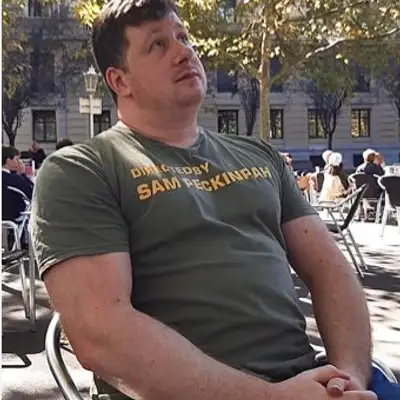
They can't see that you're wearing a directed by Sam Peckinpah t-shirt.
So, so I, I am aware that you are, you're a big, big Peckinpah guy.
And, and you're, I mean, your fandom, you know, as much as I'm hosting this podcast, it completely overshadows mine, because you've seen way more of the man's work than, than I have at this point of recording.
So, so, so, so yeah.
Talk about a little bit about that, about how you first got into Peckinpah and like, yeah, what is it that draws you to his work?
Yeah, so I, I am wearing a directed by Sam Peckinpah t-shirt.
If you want to get your own directed by Sam Peckinpah t-shirt, they're sold by Brian Sauer, who hosts the Pure Cinema podcast.
He does a range of t-shirts, which are all like director t-shirts, like this, that are kind of like directed by a certain director in kind of a font that was used for like a number of their films and stuff like that.
So yeah, I've got this one.
Well, if he ships to New Zealand, I, I, I guess I probably should get one, you know, like, you know, then host the podcast and that for the rest of the run.
Exactly.
Exactly.
I would hugely recommend that.
So I first got into Peckinpah, it would have been sometime in the 90s.
Empire Magazine, long, long, long, long before I had any involvement in it, posted an issue at one point or published an issue at one point with a book with it called 100 Videos You Must Own.
So this kind of shows how long ago it was, where it was like, yeah, it was 100, it wasn't necessarily 100 Best Films, it's just, yeah, these 100 Videos You Must Own.
And there was a bunch of Peckinpah in that.
Wild Bunch was in there, Cross of Iron was in there.
There might have been some others as well.
I mean, Straw Dogs wouldn't have been in there because at the time when this book was published, Straw Dogs was still banned by the BBFC.
So literally that would not have been in there.
But these other ones were, and they had kind of little essays about the films.
I remember reading the one, The Cross Iron and the one for Wild Bunch and very, being very, very intrigued.
And this is, you know, I'm a young film fan.
It's probably about 98, I think, probably about 98.
And I'm really, really, really, you know, getting into movies and being a cinephile.
And I was like, I've got to see these.
And obviously, you know, this is a time where the internet existed, but you weren't using it the way you do today.
There's no letterbox or anything like that.
So it was just kind of like you would get film recommendations like this from film magazines and stuff like that or word of mouth.
And I was like, I'd never heard this guy before.
I was like, oh, wow, what's this?
And I think I'd heard of The Wild Bunch before, but not like in detail.
And then one, like literally that kind of like summer or winter, I was staying in a caravan, like some kind of family holiday or something, sleeping on the sofa in this caravan.
And Wild Bunch was on the telly on like BBC Two or something late at night.
And I remember it really vividly.
It was it was started quite late.
I think it started about like 1030 at night and literally was in the middle of this film.
There was a storm going on outside or something and had this tiny little step in this caravan kind of thing.
And like it was just about holding out signal wise, like this is analog kind of like TV with an aerial type days.
I'm just suddenly thinking, I wonder if we saw it at the same time, because I was like the first thing I saw The Wild Bunch was definitely on BBC Two late at night.
Maybe, maybe, maybe.
It's like, you know, it was when you were still in the UK.
Yeah, yeah.
Like, yeah, yeah.
Like, rather than hooky set up from New Zealand, like a theme it into the BBC.
No, no, no, no.
I was still living in Scotland.
I, you know, like I didn't move here until I was like 36.
So like I was, you know, I was definitely still living in Scotland.
Yeah, yeah, yeah, yeah.
So maybe, quite possibly.
And I watched it and I was kind of like, and it's one of those things.
I just never seen a movie like it.
And certainly, I think at that age now, I really, really love Westerns.
Now, certainly, I think I, you know, I'm still slightly less interested in traditional Westerns and slightly more lean towards like revisionist stuff.
But even, you know, there's traditional Westerns.
I mean, High Noon, I think, is an absolute masterpiece.
And I'd say that's, you know, I'd say that's traditional.
I wouldn't say it's a revisionist Western, even though it's got elements of it, which are kind of quite ahead of their time and stuff like that.
But it's a reasonably kind of like traditional film.
But, yeah, like this at that time when I was a teenager, Westerns were very much had fallen out of fashion, weren't that interested in them as a young film fan.
And I watched The Wild Bunch.
I was completely blown away.
And I was like, oh, this isn't I didn't think Westerns were like this.
You know, like when we were kids, we thought of like Westerns, like cowboy and Indians, bit outdated kind of thing, like not really interested in that.
And then I saw The Wild Bunch.
I was like, holy shit.
Like, you know, it was just like, yeah, nothing else you've ever seen.
And so, you know, so intense, so kind of bloody, so violent, but also just deeply emotional.
Like this deep well of emotion running through it, which I found really interesting the way it talks about men.
I'd just never seen anything like it.
And from then on, I just got very into the idea of seeing more Peck and Parr.
But in those days, it was quite hard to kind of see more of his work.
And I think the next time I would have seen something would have been because when I started doing film studies at A-level, it was just before, just before the BBFC did this huge unbanning of loads of movies that have been banned.
Because for years, the BBFC had been very kind of ban happy, like the video nasty era and everything like that.
And then basically the guy who was heading the BBC retired or died, and a new guy took over.
And he started unbanning all of these films that have been banned, including Straw Dogs.
But just before that happened, I started film studies in college.
And the tutor did a season called The Shocking Cinema Season, where it was all these kind of banned movies.
And at the time, obviously, like I say, a lot of these films were still banned.
But because we were students of film, we were allowed to see them.
It was you give them special discontentation to see them.
And so I saw it and was just like, wow, like blown away again.
Like, but again, like his movies, I'd say like the ones I said, all of them, they grow with me over time.
Because both Wild Bunch and Straw Dogs, when I first saw them, I don't think that I loved either one on first viewing.
I liked that.
I really liked them.
I was really fascinated by them.
I really appreciated them.
But I think I've fallen in love with them over time.
And now Straw Dogs is one of my favorite films of all time.
Like, it's in my top 10 films of all time.
It's my favorite Peckinpah film.
You know, Wild Bunch is also a masterpiece.
But this is after like lots of viewings of those films kind of thing and just falling in love with them more and more over time.
And so after that, I kind of really got the Peckinpah bug, became fascinated by both those films and kind of rewatched them again and again.
With like, you know, this is the birth of like the DVD era.
So I got them on DVD, watched them all the commentaries and all that kind of stuff.
The time when we had the time to watch movies or commentaries, everything get more and more.
And, you know, that's how I discovered through then that there was a group of kind of academics kind of known as the Peckinpah scholars.
People like Paul Cedar, Nick Redman and stuff like that, who were real Peckinpah obsessives.
And they did all these commentaries.
And that was really fascinating.
Started hunting down documentaries.
And then when I came to do kind of, you know, I guess what would have been not a dissertation because it was a level, but final major project or whatever the case at a level.
I decided to do it on the work of Sam Peckinpah.
And thankfully, Brandon, my my main film tutor was also a Peckinpah obsessive.
And he that's why he programmed Straw Dogs for the shocking cinema season.
And he was really into Peckinpah.
And he had loads of his movies recorded onto the old VHS tapes off the telly.
You know, this is the old school where it's like those are the ways because this time there was a couple of his films were on DVD, but not even that much.
And long before Blu-ray or streaming.
So he lent me all these VHSs.
And that's how I banged through a lot of his work back then at that time.
And yeah, and since then, it's just been more and more pretty much over.
I think at this really intense period of doing A-levels and then doing a film production degree at university.
And basically every time I had a chance to write about film and I had the choice to write about what I write about.
It was always about Peckinpah and his work.
So I've written like countless essays and articles and stuff about Peckinpah and his work over the years for one reason or another.
And that's when really at that point, that's it.
I was in love with Peckinpah and his work and was just fascinated.
Read, you know, every book there is available at the time.
Like saw every film I could get my hands on kind of thing.
And just, and that's, you know, just continued.
I've still got a huge amount of love with him.
The thing I always say about Peckinpah is I don't think he's the best director who ever lived, but I think he could have been.
If he would have had the opportunity because he lived in a time really where he came just before the Mavericks, like your Scorseses and Francis Ford Copplers and stuff like that.
And he came, even though he did work at the same time as some of them, he came in just before them.
And he kind of had already been ravaged by alcoholism battles with the studios and stuff like that before he got to that point.
And I think if he'd came about in the same kind of era as those guys and started doing the majority of his work in the seventies and stuff like that.
And he hadn't already been so jaded by the Hollywood system before then.
I think he could have just flourished a lot more than he actually ultimately did.
So I think that's a great show.
Yeah.
Yeah.
Although, I mean, like you never know how these things go.
And like, you know, and the special features of the of of of of Straw Dogs.
There's like that.
I've got the DVD.
I've got the 40th anniversary edition.
You know, like I guess the is one of his biographers, Garner Simmons.
You know, he talks about like he felt that like what really killed him in the end was the coke that he got into in the mid 70s.
But I mean, he was already ravaged by drink by that stage.
So like maybe just the final the final nail in the coffin.
But like, you know, that might have been accelerated.
I don't know.
Like, it seems like he had like a particular a particular contrarian, a particularly addictive personality that like he might have self-destructed.
Whatever the era and circumstance.
Yeah, I think that's very true.
I think I suppose there's like you read about the story of Hec and Par being found outside the premiere of Major Dundee in floods of tears and being like those bastards took it away from me.
And it it hit him so hard.
It hurt him so much.
That film being taken away from being butchered by the studio.
I don't mean, you know, it only got released in any even anywhere near some kind of form.
He might have approved of way after his death.
I think like, you know, yeah, I mean, that's true.
Yeah.
So it's just and I think in a way, I think he kind of like never got over that in terms of like that.
He always felt I think that he'd always be fighting for his vision on screen.
I don't know.
I was like, I think he did have an incredibly addictive personality.
And I think he did have a lot of problems.
But I suppose I think that maybe if he would have been able to kind of get his art through unfiltered from the beginning, maybe he would have kind of found solace in drinking drugs less.
Maybe maybe that's naive.
Maybe ultimately he was an addict and that was it.
And kind of like, you know, no matter what, he would have gone down that route.
But yeah, I don't know.
I just think that I think we missed out on Peck and Park classics that we didn't get because he was tired of fighting the studios.
And I think that, you know, so many of his movies, he got taken away from him and kind of changed everything like Pat Garrett and Billy a Kid.
Like, you know, there's a film where there's multiple versions of that movie.
Yes.
And the perfect one isn't out there in a way.
It's like literally it's a film.
Pat Garrett and Billy a Kid's a film where I'm going, that's a five star masterpiece.
But that five star masterpiece version doesn't exist out there.
It's like it's you have to take all these versions together and kind of like kind of patchwork them together to get the five star masterpiece going like, you know, there's there's my preferred version was the 1988 Turner cut.
That's that's my preferred version.
But like a bit is that thing of going like this.
Even then, there's little bits and pieces from the theatrical and little pieces from the cut that came later.
You mean like the 50th anniversary one?
Yeah.
There's one on the there's one that Paul Cedar did.
And then there's which I think is probably the 50th anniversary one.
Then there's a more recent one as well, which was released in the criterion.
And all of them have things that can be recommended about them.
But they also have things where I'd be like, I wish that wasn't there.
I wish like, you know, this was different.
Like I say, Turner cuts my favorite.
But it's just, yeah.
And I suppose it's I just it frustrates me that I'm just kind of like there's another masterpiece we could have had.
And it's just because of this.
Never quite, never quite there.
But yes, that's that's what I think about about him.
So I admire him hugely.
But you're also very problematic and controversial figure as well for good for good reason, which I'm sure we'll get into discussing this movie, which is his most controversial work.
Fine.
Yes, yes, it definitely is most controversial work.
So now we kind of move on to our conversation about the actual film at hand, Straw Dogs, which, you know, I mean, this is the peck and pa pun.
Podcast.
And I think that people expect us to talk about strong material and I don't usually give out trigger warnings.
But I think maybe it's applicable in this case that there will obviously be conversation of rape and sexual assault because it is central to the story of the film.
And it is also central to the controversy around the film, why it was banned on video in the UK and why it ran into censorship problems pretty much everywhere it was released.
And so just giving you the heads up there that we will talk about that because it is a big central piece of the film.
So like if that is disturbing to you or you don't want to listen to that, you can turn the podcast off now.
But yes, I just thought I would give people a heads up of that, you know, because obviously it's a very sensitive topic and some people just don't like hearing about that.
So anyway, before we get into kind of that piece of it, you've kind of you have talked a little bit about Straw Dogs, how it's your favorite pecking part.
And one of one of your top 10 of all time.
I didn't I didn't know that going into the podcast.
I am also a fan of the film.
I would say it is one of the three films that got me into Peckinpah.
This is the Wild Bunch and Bring Me the Head of Alfredo Garcia.
So I'm definitely.
But I I I think I love Wild Bunch and Bring Me the Head more.
I feel like I have a more complicated relationship with this film than than than I do with those other two, even though Bring Me the Heads is actually kind of even more nihilistic in this film.
But yeah, there's, you know, it's strong stuff.
And, you know, it it definitely brings a lot of reactions in people.
And I think it is a great film.
But, you know, I am conflicted about certain certain parts of the film.
But I guess like it's it's it's best just to kind of dig into it right from the very start.
I mean, like I guess if people haven't seen the film, the film centers on a couple.
David played by Dustin Hoffman and his wife, Amy, played by Susan George.
He is an American.
She's she's an English woman.
And they had previously been living in America and they have moved back to Amy's childhood village in Cornwall.
And they move into Trencher's Farm, as the name of the novel suggests.
And basically they are troubled and pestered by the villagers pretty much from the off.
And it all ends up in a in a lot of violence in in in the end.
But yeah, there's it's very tense.
It's very suspenseful.
And for the most part, it is a very tense thriller.
And then you could possibly argue it becomes a horror film in the last kind of half hour.
I don't know if it would necessarily be defined as a horror film, but it certainly goes into that territory.
You know, I can only.
I feel like a lot of home invasion horror films were probably influenced by this film.
You know, like I feel I feel that it definitely has a massive legacy and an influence.
But I guess maybe before we get into the plot of the film, you mentioned like how close to your heart this movie is.
Maybe just like we'll start the conversation by just talking a little bit about about the why of like what what is it about this film that like really strikes a chord with you?
I think it is a deeply and transgressive piece of work.
And I think it still is, which is a pretty crazy thing to say, considering it came out in 1971.
But literally 50 plus years later, I don't think it's lost basically any of its power.
I still think if you release this in cinemas today, it would people would react basically in exactly the same horrified way.
I think it is.
I think it's an inherently violent film in a really interesting way, because it's not actually.
You know, you've talked about Wild Bunch on here before about like, you know, use more squibs than any other film and stuff like that.
Wild Bunch is violent in a literal sense in terms of the there's blood or everywhere.
Whereas Straw Dogs, there is a few bits of blood and gore here and there.
But in general, you don't really see much.
But it is an inherently violent film and it feels violent at all times.
And I think you mentioned about Sam Peckinpah making films about toxic masculinity that kind of bridge this line between kind of kind of embracing it and also satirizing it.
in some ways or critiquing it.
I think he is just.
One of the most honest filmmakers has ever been about masculinity and the male psyche.
I think this film kind of.
Basically digs in to the male psyche in an extremely real way.
The other films have been frightened to do in the sense.
So I kind of think that Sam Peckinpah made years and years before this would have even been a thing.
Mayday.
It's all men.
So long before we were having those kind of discussions, because essentially what we have here is our lead protagonist, David Sumner, is this intellectual, very buttoned up, very middle class, very kind of like, you know, thinks he's above all of this stuff.
You know, all these violent tendencies all the way through the film.
He's not sinking down to their level, as he kind of puts it.
And in the end, of course, deep down, he's a brutal, violent psychopath like the rest.
And actually his lust for violence is just as insatiable as all the others.
And it really is a thing of like, you know, you see Amy.
Susan George, who I think is transcendently amazing in this film.
She is not safe with any man in that movie, including David at the end of the day.
And, you know, by the end, she is horrifically brutalized and traumatized in every way.
And, you know, who would be painting himself as the hero of that story?
She is just as terrified of David as she is the guys who would try and invade her home.
And I just think it taps into something deeply dangerous and savagely primal that's just not been replicated in this way.
And I think for me, like, that's fascinating.
And I think the reason, if you look at even the contemporary reactions of male critics from the time, I think it's extremely telling that the critic who really got the film or like, you know, or appreciated it at the time was Pauline Cale, who was one of the few prominent female critics of her era.
At the end of the day, who was frightened by the film, but also considered a masterpiece.
Whereas many of her contemporaries at the time, Roger Ebert included, were very dismissive of the film, very much turning those up, being like, because they were all David Sumner.
They were all the kind of guy who Sam Peckinpah was parodying in this.
And of course, there's an element of self-loathing in there, because lots of people who knew Sam Peckinpah said that Sam Peckinpah, obviously, he modelled himself on all the cowboys, the pikes, and everything like that.
But actually, David Sumner was the character who's closest to him in reality.
Well, yeah, I mean, like, which is, I mean, it's interesting, because like, one of the tidbits that came out of the research was like, he's not called David in the novel.
And like, and like, David is actually Sam's actual first name.
He just went by Sam, as Sam being his middle name.
So, so yeah, and like, that's like a common theme that runs through Peckinpah's work of his, like, many of his lead protagonists being partly bits, partly biographical, you know, like, there's, there's, there's, there's bits of him in kind of all his male leads.
Or certainly in this era. So no, that's very true. And I do think you, I do think you're right. I do think that the reactions would be similar to what they were in 71.
And I think the, the things that people praise about it would be similar. And I think the things that people criticize about it, um, would be similar. And I think that like, yeah, you know, because if you release it to, you know, basically, back then, you know, people accused it of being misogynistic.
And fascistic. And fascistic. Um, and I think that like, people would also accuse it today of being misogynistic and fascist. Um, which I don't think.
There, I think there, there is, it's, it's, it's, I think it's like, it, I think it's truly an impressive work. I think like it, it brings out emotion in you, whatever, whatever way, whether you love it, whether you hate it.
And I, I think there's, there's parts of it that feel misogynistic to me, but again, parts of it feel like it's, it's pointedly, um, talking about misogyny and not, not being misogynistic, but just, you know, just, um, visualizing that and, and, and just showing and just showing you how awful that is.
But at the same time, there is parts of it that I do feel veer into misogyny. And, and I think with the, with the fascism thing, I think that like, I don't think that this leans into that.
Cause I think like the, the criticisms that says that it kind of glorifies like violence or mob justice or any kind of like might is right kind of fascism thing.
I don't, I don't think it's really doing that. I really do think it is. I really do think it is criticizing violence.
I really do think that it's saying all of these men are awful. All of this violence is awful. I don't think like, if you watch, I mean, there's plenty of other revenge films that I would, that I would say are, are wholly fascist.
I would, I would say death wish or Cobra or any of those types of films. They are absolutely fascist, but I don't think, I don't think, I don't think, I don't think,
I think the, the, the misogyny conversation is more complicated, but I think I, I, I wholly reject the kind of, the kind of fascism criticism that the film gets.
So do I, I agree with you in the sense of, I think it's the films that inspires that more have that kind of, you know, going for the Michael winner death rush films for certain, um, are a hundred percent deeply fascist.
Like going like, and literally, I don't think this is funny enough.
I, I don't necessarily think this film is anti-violence, but I don't think it's pro-violence either.
I don't think it's either one.
I think it's just depicting what Sam Peckham par believed the truth of the kind of male psyche is propensity for violence was.
I think that he was trying to say, we all have this within us.
And if you're not willing to confront that, then you're lying to yourself.
And I think to be honest, when you look at what's happened since, I think he's been proven to be right.
You know, it's like, this is exactly what I'm talking about.
Those, the kind of, uh, middle-class liberal intellectual male critics who were appalled and continue even to this day to be appalled by this film.
Um, for me, or exactly the kind of people who are kind of running away and trying to deny a part of themselves, which they don't want to confront.
Probably the kind of people who would be hashtag not all men like going like, you know, in terms of rather than going like actually, yeah, you know what?
There's, there's something, there's something in the blood when it comes to men, however much we want to deny.
And if we look at what's going on in the world right now, which is run by men at the end of the day, and literally the horror that's happening.
And, you know, a lot of it comes from, um, you know, uh, male politicians or kind of influences and stuff like that, who, uh, political commentators who are going like, oh, we've been told we should apologize for being men.
And now we will do this gunning after that.
They're reacting to that.
And it's just kind of, yeah, this is, this is the truth of it.
And, you know, to try and pretend that people haven't got that in them, I think is naive.
The, the thing that's, you know, that you explore and you have to say, yes, we all have that within us, but it's to do with how, what you choose to do.
You have a choice with how you act.
We're not animals.
It's not saying that kind of, you know, there's, there's no choice in the matter that it's a case of like, you know, uh, like you have to do this.
Having something, the propensity for something in you doesn't mean you're going to do it.
Okay.
I think like, so I think, I think that that's exactly kind of what it's saying.
I think that's, what's interesting about it.
And it's certainly, I certainly don't think it's pro violence at all because ultimately the character,
Dave Sumner, he isn't the hero.
He doesn't get to be the hero at the end.
He doesn't get to go and hug, um, Amy and like kind of, you know, embrace her or anything.
No, he goes up to her and he puts his hand on a cheat and she's utterly repelled by him.
She's scared of him.
Like she's terrified of what's happened.
And then he leaves the house.
And obviously, you know, you have that amazing final exchange where Henry Niles says to him, I don't know my way
home and he says, don't worry.
I don't either.
And they drive off into the night because he's gone.
That's it.
The original ending of this film, of course, was that the police would turn up and David would still be in fight or flight mode and would start shooting at the police.
Like from his, and that for me really kind of, you know, I prefer this ending because it's subtler, but he's saying the same thing of like, he's gone now.
Yeah, he is.
He is.
Fucking loco.
Like, you know, maybe he will never go back to that house.
Like, you know, you don't know what he's going to do.
Like the thing, you just see that car driving off into the night.
And as the kind of shot is so dark that all you can see are the headlights.
There's no frame of reference there.
And it's just kind of like, that's his kind of like mind going off into the darkness, you know?
I think the one difference, I mean, because we're kind of talking about, well, I guess we'll get back to the start of the film.
But like, we're kind of talking about the end and we'll kind of talk about that.
I guess like the one difference in terms of like what you're talking about, the propensity towards violence.
Like to kind of, I guess, I don't think this film is as good as this film, but like just to compare and contrast.
I think like everybody like has like that within them, but like, for example, in something like Last House on the Left, like there's, they fight back out of like out of a mixture of like survival and kind of wanting revenge because of what happened to their daughter.
But like, there's, there's no point where they fight back, where you're like, well, they're really into this.
Whereas, whereas, whereas, whereas, so like, so like, I think there is a bit of a differential there.
Like you can say that there's a propensity towards violence, but this character of David and Summer specifically, you get to a stage where he's almost invited it in.
He's almost, he's almost thrilled by it.
You know, when he's like, you know, when he's, when he's, when he's, you know, cooking up his things and like, you know, he's got the, he's got the, the, the hot oil boiling on the hob and stuff like that.
He, he, you know, at a certain point he is thrilled by the violence.
And I think like, that's not in all of us.
No, he's getting into it.
But the thing is, it's, it's funny.
Cause I, I know it's funny.
Maybe it, maybe it isn't, but I feel a connection with that.
The adrenaline rush of what he's doing and everything.
The fact that he's just like, something happens and the shutters go down.
And you know, it is what of course is brilliant about this film is in any other movie of this time.
It would be a rape revenge arc.
Of course.
Like where essentially he would know that his wife has been assaulted and be like, I must now be the white knight and get revenge for David.
Someone never finds out what happened.
In the movie at the end of the day.
And so all these fights, it's for him.
He's the one, the whole thing is like, he said, I will not let violence be committed against this house.
And it's all about this house is my castle.
He's been humiliated by these guys all the way through.
And that's what he's fighting for.
That's what he's interested in.
The end of the day, isn't anyone else.
This is for him.
And, you know, when he goes out at the end, after he thinks he's got everyone, it's like, Jesus, I got a mile.
Like, he is elated with himself for what he has done.
You know, he is like, hey, like, I fucking did it.
But yeah, it just, yeah.
And I, I, I find that completely fascinating.
He has no motivating factors in terms of from what you could paint as being notable.
Hmm.
Which I mean, like that arc in it, because like, it does make it a more interesting film because like that arc in itself is, there is like a misogyny in that arc of just being like, you've, you've like, you've taken this story of like something that's happened to a woman and centered on a male.
So like, you know, like there's, so there's a more kind of eye rolling factor to that because there's plenty of films like that that you're like.
Yes, exactly.
A lot of the films it's inspired.
Yes, most of the films it's inspired are, are, are, are like that.
And like, yeah.
Um, and I come across kind of more misogynistic than this film.
Um, yeah.
So, I mean.
There's a direct parallel between him and the men he's fighting.
because the whole thing is is he doesn't know what happened with amy and the whole reason the
like mob are there at his door is because they believe something has happened to their ring
leader's daughter but again they don't know no one none of those characters ever find out what
actually happened they suspect something happened what they do is they suspect something happened
then they go to the pub get drunk and go there rather than looking for his daughter which is what
they should be doing so let them ever find out what actually happened they never find out she's dead
and she was killed or anything like so again they're just looking for an excuse for violence
yeah no everybody in the film all the men like and again um yeah all the men in this film are looking
are looking for violence and and i mean like you know as as much as like throughout peckinpah's career
he's often been accused of of misogyny but again this is another film where you know it is the female
characters it's particularly you know susan george's character on her own amy um who is ends up being the
voice of reason and she she does you know there is a point in the film where she's like because there is
there is this suggestion that that david kind of wants this final confrontation because there is a
point in the film where amy just says like we can just fuck off you know we can just go and he's like
no we're not doing that and and like yeah even before the violence starts like because like it's one of
those things it's like each time you watch a film like you remember parts of it and like you you might
forget other parts of it and like the you know watching this again i thought like a niche i thought
like the the character of david's like kind of curdles throughout the movie throughout the arc of the movie
but like starts as like an inhale like an like just like a like a decent guy like a decent fella but um
but he doesn't he doesn't all the men in this movie are terrible um he is there like um the other the
workers um all the you know uh charles and russell and all those characters are are awful in a kind of uh
very crude neanderthal type way but like um david is awful in this kind of way that he like he thinks
he's above everybody he frequently um talks to to his wife amy who is significantly younger um you know
because like when this movie was made dustin hoffman was like 33 susan george was only 20 um but like
talks to her in in this kind of really awful way and kind of treats her like a kind of child um and like
yeah so it can everybody from the very and i didn't remember that that like can everybody
all the men from the very start are terrible people yeah well there's a lot of stuff about class
in in the movie and these resentments between kind of you know david who is this very much
it preppy intellectual kind of thing like not only in differences between class but differences in
culture as well because he's american um but like you say he's he's he looks down his nose at these
people he dishes out like microaggressions to them he kind of like talks down to their condescending way
and kind of uses his he thinks sees them as stupid he uses his intellect to kind of be like get one over
on them i think and but things that will go deliberately above their head and stuff like that
um but also the way he treats amy like you say is he he talks to her like he's her father or her
teacher of course the inference is that she was a student of his because he was a teacher but
certainly there's that inference there uh which is like if you kind of if you kind of trace that that
is like a like because like the inference is that they've been married maybe what a couple of years so
they were married when or maybe a year like so she was like maybe nine 18 19 when they got married
is that is that yeah i didn't i didn't know i didn't know about that i didn't know whether they
were kind of like newly married and this is there and they've just because they've clearly they've
clearly only just very recently moved to move back to the village that's fresh that's yeah that's
they've they've they've freshly done that but like i don't know the way i was like the way i was like
you know the way i interpreted it and because like the way they kind of talked um it like susan george and
that in interviews of like how you know peckinpah got her and um dustin hoffman to like live in the
kind of hotel together for like two weeks before shooting started and all that like that's just that there
was like a honeymoon period and then and then they came and then they started to go in the rocks and then
they they they moved here because they thought it might save their marriage kind of thing so i i thought
like maybe at least a year um see it's funny i i've always read it and i i think it is ambiguous i've
always read it is ambiguous i'm just reading into it yeah yeah yeah yeah i've always read it as they're
newly married i've always read it as in they got they got married in america and then i've always
read it as this is their first like homesteads like as a married couple right like i always assume they
got together i always assume she was a student in america that's how they met because she went off to
america to study um they met he and obviously you know this is a time where teachers could date their
students going like you know he did that then they got married quickly and then moved back she was like
let's move back to my uh village and he was like oh yeah that'll be good because i'll be able to write
my you know my project to my book i'm working on or whatever the case um and they and they come back
that's how i was read it um of course like i say i think it is open to interpretation uh very much
but i i this is the thing i think the reason i read it that way is i don't read it as they're on the rocks
like i don't read it as their marriage is on the rocks and they've come back to save it
i always read it as this is just inherent in their relationship because their relationship is not a healthy one
because ultimately that age gap and the power imbalance and stuff like that um just ultimately
shouldn't be she is far younger than him they clearly met at a time when he had more authority
in the kind of relationship and he still treats her like a student like uh like a father there's loads of
moments where like you know there's that bit where she's kind of sitting next to him almost like
she ends up kind of like bunching up in the seat like a little kid um and you know the bit with the
chalkboard was like i'll do it amy like um and it's you know they've very much got the ratio the only time
that they actually seem like they're having fun and this is an interesting parallel in the sense of why i
think that they are i think they are freshly newly married it's like anything of around their sex
lives or kind of you know flirtatious and stuff like then they kind of descend they act like a couple
of teenagers together yeah all of a sudden and suddenly they're all really flirty and they enjoy that part
they're fun with that part but anything outside of that like as soon as basically it's like as soon as
he's had sex or whatever he's like right i want to get back to my mathematics and now you're annoying me
yeah yeah yeah yeah yeah because like yeah one of the one of the few kind of fun of like fun bits of
the marriage there is is like you know like during the chess game or whatever you know like where they
they know that and that's quite that's quite fun in 40 and and kind of like they seem to have like a fun
moment there that that is interesting i i like i wasn't yeah i wasn't i wasn't sure i wasn't sure
because like i i don't know maybe i yeah i've read into it in a different way i guess like i thought
like maybe they've been to get like i didn't think they've been getting for ages so i just thought
maybe a year or something and also like there's but there's a lot of ambiguities in the film because
like there there's there's there's things that like are said that you're like what you could read a
bunch of things into it like you know the way they have like an argument um about him like standing up
for things and then there's there's like suggestions that you didn't stand up for things back in the
states and you're like what's that what was it like we are they running away from something particularly
or is it is a more general societal thing like he maybe wouldn't get involved with the the vietnam
protests or something like i don't know like i i like it's it's like there's a lot of things that you
can kind of be like kind of fill the gaps and kind of create your own little story of like you know
what led them here you know it was it like a confrontation in the university was it a confrontation
like yeah like one of those kind of brother you know they wouldn't get involved in that kind of stuff
like you know what was it there um but yeah it seems like they're kind of it's it's for their marriage
but like it seems like they're also kind of running away from something else as as well that like or you
know they just didn't want to be involved in american society in that moment um so like it's it's curious
it's curious i don't know no what you read into that like that that kind of conversation and they have
there um if you can yeah i think that stuff is interesting like you say really ambiguous in terms of
there's definitely a reference or hint towards something going on like running away from something but you are like
running away from what i think again i've thought similar things to you in terms of it did something
happen at the university was it even that you know he was dating one of his fucking students and that
was a problem i don't know like you're in trouble or something yeah exactly i don't know but also there
is this all of the uh cornish characters in there are all fascinated by america and hilariously
keep kind of referring or acting like america is this really violent society like in opposition to them
who are like clearly also very inherently kind of violent stuff because you know earlier on the workmen
they ask him about like you know clearly like you say i guess referring to things like vietnam protests and
civil unrest and stuff like that um and yeah they're like they're really kind of uh they're really
fascinated by it and really kind of quite into the idea and they're like were you involved in it mr sumner
like yeah it's just really they want to know they're like fropping at the mouth about about it i want to
and then later on with the vicar he's kind of like talking to him and they're talking about like the
the nuclear bomb and stuff like that and there's very much this kind of slight uh moral thing of putting
on like the american society of like oh yes warm hungry uh you know gun culture and all that kind of stuff
um onto them it's interesting because obviously it's directed by an american
um in the uk and it's an interesting thing because obviously i think uh funnily enough i think there's
some parallels with um i don't know if you've seen the drama yet yes i've seen the drama yeah yeah yeah
i think there's some parallels with that film in the sense of you know that is all about that has a british
character being very much like oh well this is your culture isn't it like you know it's all about guns and
everything like that that's inherent within all of you and he's kind of making that call and here we
have from american perspective of like you know this thing of a slight you feel like he's depicting these
like british people has been saying oh americans like you know such a violent kind of nation but then
they're really like savage you know what i mean like so it's just yes it's interesting it's fascinating so we we
talked quite a bit there about kind of like david and amy's marriage and i was thinking that like i do
feel that this could have been like quite a different film because susan george was like peckinpah's choice
whereas like kaufman originally wanted somebody who was slightly closer in age who's maybe like seven or
eight years um younger and like they didn't they had there was a time where they were thinking about
possibly like jacqueline bassett or helen mirren and that seems like it would quite radically change
the relationship in the movie because you couldn't imagine either of them playing the character in the
same way obviously they're a bit older um they would be much more toe-to-toe they've much more kind of
equal to hoffman's character and the way it was portrayed i would i would assume so like
it's it's quite it's quite interesting i don't know like um i can't really imagine
um either of them in it just because of how radically it changes the central relationship in the movie
i think helen mirren could have done it um i think it would have been different i think it would have been
different but i think she could have done the role and they could have adapted it to her to make it work
um i can imagine her playing that part jacqueline bassett completely wrong for the part in my opinion
like i just think it's i think jacqueline bassett is in the michael winner version like yeah yeah so no i
agree i agree i think yeah no i agree i think jacqueline bassett totally wrong i could also see helen mirren
in it um and i could i could totally see her doing it um but like i just
helen mirren has a naturally steely screen presence that like is obviously a very different energy to the
kind of uh girlish energy that susan george is giving i think she's you know like she's like because
throughout the movie she is seen like portrayed in a way that also she's obviously on it and she's
quite a razor sharp character in in many ways but you you know what i mean so it's just like a it's a
very different presence in the film yeah very different i mean funny enough i helen mirren was 26
um at the time and weirdly if you actually look uh photos of her from 1971 i'm just looking at uh
photos from like an observer photo shoot um from 1971 she does have a really similar look to susan
george obviously yeah it's slightly older slightly older but but not not by a huge amount at the end of
the day and she does have she's only five or six years older yeah something like that yeah yeah yeah
yeah i mean she certainly could have played like you know because the whole thing with uh with amy
with susan george's character is very much the inferences that she was kind of you know like the town beauty
wasn't she like you know she was not only the taboo but also she she is very smart she is very intelligent
yes like yeah she went off to america to study and everything like that she is um you know in many
ways that there's this push pull with her between her relationship with david and her relationship with
kind of the people from her village um and you know that there is in a lot of ways she certainly seems to
have a lot more in common now uh with with david than she does the villagers and she has moments of
kind of uh you know definitely feeling like she's looking down on them a little bit because she has
elevated herself so much um in terms of that and you know she is this absolutely kind of like gorgeous
woman and you do feel like they are kind of that part of the reason they're like resentful of david's
like you took her away from us yeah yeah yeah yeah you robbed us of our you know town beauty queen
kind of thing and you feel like helen mirren could have definitely fulfilled oh yeah no absolutely
had the steeliness and she is also a brilliant enough actress to have totally sold the kind of
emotion of the piece as well but i i just think that i i do think ultimately peck apart made the
right choice not only because i think sue george is incredible in the film but also because i i think
her being younger is important i think they that age gap that the fact that she is she is a girl in many in
many ways still um and you know when that comes up like at different points in the film where it's like
this thing of like david patronizes her terribly but at the same time there are moments where she
reminds you that she is still young and kind of like you know isn't kind of thinking straight about
things and stuff like that so yeah i i totally think he made the right choice and i think it was
a very i'm really glad he like held firm on that and was just like no she's i've decided she's the one
and that's it and i think he was right on no i i i think he was right ultimately as well and i agree
with you i i very much agree with you i i think susan george um who's not an actress i've seen her
work extensively but like but she is tremendous in this film she she i mean she gives an a plus plus
performance in this film you know absolutely um yeah i mean susan george may have wished at times during the
shooting the film that the role had gone tell her like yeah because she had a tough time during the
shooting of this movie um she did have a tough time she did she did have a tough time and she did you
know she did walk off the set at least once um yeah because um because she was annoyed because like and i
guess we should get it um because with the rape sequence um nobody would tell her what it actually
entailed it just said in the script that there was a rape sequence and she kept asking and asking and
didn't get an answer and didn't get an answer um and then eventually it came to basically the day of
shooting the thing and she was like okay you've got to tell me now i can't you know i need to know what what
is coming i need to know how to react to things acting is reacting you know that's the whole thing
and um peckinpah finally caved and said this is what this is what i want and she was like no i can't
do that and she walked off um and then and then there was a conversation she was brought back and um and then
yeah i mean obviously it was a very tough shoot for what they actually did and she did agree to what they
actually did but still um peckinpah was very demanding in a way that um old school directors were
and probably wouldn't be acceptable now um and but i mean i guess we should point out uh we i guess we
should point out that he was a very hard taskmaster and probably um acted in a way during the shooting of
this that is not acceptable now but it's not it's but also comparing it to other 1971 films it's not
uh last tango in paris story situation you know like it's it's it's not that far over the line it is over
the line but it's not that far over the line i think we should clap it is over the line like it's absolutely
over the line but it's it's also not out of place with the way a lot of male directors acted then i
don't think it's not far away from william freaking shooting a gun past someone's head to get a reaction
oh no i think i think that you know i think when you look at directors of the time when you read about
directors of this time when you read about freaking when you read about kubrick when you read about all
these these guys who were directing um in the 60s and 70s and beforehand um it it's definitely
um it would i think it would have been it see it would be seen as very outrageous now but you know but
like the kind of i think it was definitely more accepted then of like this is you know this is what the
the genius director does to get the the ultimate performance from from the actors or whatever i
think that was the thinking at the time uh wrong-headed we would consider that wrong-headed now i definitely
do and uh but but no i don't think it's that far away from what a multitude of other quote-unquote genius
directors were doing on their sets yeah i i think that's exactly right um i think it is still completely
wrong and i agree with you completely in the sense of i think that attitude of this is what you have to
do to get a great performance completely wrong-headed um like you say i mean sam peckham bar uh treated
susan george awfully in the lead up to the shooting of the rape scene because he essentially was playing
psychological mind games that he uh you know i'm sure people who kind of you know defend this kind of thing
to the hill or you know even him would say he was doing it to get the performance he wanted out of her
um but actually i think what the story proves is how much that's followed because ultimately she
claimed ownership of the performance away from him and she's the reason the scene works so well in my
opinion because in the lead up he wasn't telling her what the actual content of the scene was gonna be
but he was constantly bigging up the scene to her constantly he constantly said i want to shoot the
greatest rape scene of all time and he just kept hyping it up to her that every day be like yeah everything's
gonna be amazing and like and it would frighten her because he was just bigging it up so much apparently
one day her parents were going to be visiting the film set and literally at one point he like growled in
her ear like you know perhaps i'll make sure we're shooting the rape scene on that day so your parents
could see what their little girls really like like yeah just like and he's just the really despicable mind
games he was playing with her um and then when it came down to it when she finally put her foot down
and said i need to know what's happening and then kind of walked off came back what she said in the end
that she would do because he wanted it he wanted the nudity to be really really graphic in the film now
obviously she you know there is uh she's like topless in the scene everything but only for really like
one shot kind of thing like the majority of it you're concentrating on her face um but apparently
originally he wanted it to be really graphic nudity um and be a very very graphic scene like um and
she basically convinced him to allow her to play it much more through her eyes
um and through her face and you know and he ultimately while there are like some shots of her breasts and
stuff like that like the majority of it is on her face the majority of it is on her face and she does play
it through her eyes and ultimately like i say i think it's because of her that the scene works um no i
i absolutely agree yeah yeah yeah yeah i think it is an incredibly controversial scene for a reason
and i think there is lots of stuff you could talk about within it that you could take issue with um
and i am very aware that we are two men talking on a podcast about a scene like this that there's no
getting away from that so yes you know i say this in a way that's very much my opinion from someone who's
you know watched the film countless times read interviews with very extensive interviews with
susan george about the scene um and read a huge amount about the making of the film and you know i
genuinely believe the scene deserves a re-evaluation um because i think that susan george took ownership
of the scene through her performance because everything is unsaid in the scene nothing is literalized
within the script so essentially it's all through her performance um in regards to that and basically i
mean you know obviously the it's two rape scenes back to back in the sense of first she is raped by
charlie venner um who we find out was clearly an ex-lover of hers when she was still living at home
um and then she's raped by scott who's one of the other workmen working on the house and there is a
there's a difference in the way the rapes are depicted in regards to the second one with scott is clearly
incredibly horribly violent and forceful and it's very very clear that she's being taken by
force and that there is there's no ambiguity about that second right that it is just right the first
right with charlie there is a school of thought because of the way she reacts in the scene
that leads you to believe that the film is potentially telling us that she is beginning to enjoy
what she's experiencing which is obviously why it's so controversial um however my reading of the scene
uh through susan george's performance and watching her turn in that scene is i think she demonstrates
the fear and anger that's palpable throughout that sequence and also if you read on rape crisis um the
uh group um in regards to four rape survivors um literally they actually talk a lot about the five responses
that are our body's way of protecting ourselves from further harm and surviving a dangerous situation like
sexual assault which are fight flight freeze flop and friend and all of those things
are things that to my mind in susan george's performance she demonstrates that amy is doing
throughout that encounter because of the fact that she does have a prior relationship with charlie and
um deep inside some kind of emotional connection to her that she can use to survive the situation and make sure
it doesn't get worse that she doesn't get the treatment that she does get from scott um and she essentially does
she's managed it's a case of going like of surviving the situation and getting through it and you know in
in applicating her attacker essentially and at the end you know a single tear rolls down her face
and i kind of think her performance says it all in regards to that in terms of what she's doing i i don't believe
she's enjoying what she's experiencing i don't believe that she's kind of you know um kind of
kind of fallen back in love with charlie or something like that i think she's just trying to survive the
experience that's my reading of it and lots and lots of people i'm sure will disagree i think but that's
how i read her performance so that i mean like
in some ways i like and i'm like thank you for for for saying that and and also um um i i would say like
you i i want to you know i want to say kind of the same thing about like you know i understand we're two
two men talking about this you know so that's you know that i mean we can't change that you know that
that is what it is um and um you know like um so maybe our perspective isn't isn't the best so this is
this is just this is just our perspective i kind of share your sentiments i i i think that like i actually find
the discourse amongst some of the defenders of the scene kind of maybe the the most problematic thing
um um sure um because like and like because like because i you know the first the first few times i
saw this movie i had always read it the same way you're kind of reading it through susan georgie's
performance um so through susan georgie's performance i always felt that the scene was like it is it's
it's an awful rape and to kind of like you say placate the attacker um she kind of um
she knows that in whatever sick and twisted way like you know charlie has some you know infatuation
quote-unquote love for her um and to proclaim proclaim him you know um acts in a way to make it seem like it's she she
wants it um so he doesn't hurt her more because like up until that point it is is is incredibly rough he's
slapping her about he's you know he he kind of in a very savage feral way kind of snaps her underwear off
it's it's very there's a lot of violence and then and then that that violence comes down
and once she goes into this kind of mode of like seeming like it's quote-unquote pleasurable so i've
i've always i've always i've always i've that's the way i've always read it um um yeah like like
listening to the susan georgie one of susan georgie's interviews um she like um apparently in the script it was
kind of made like you know it says you know she finds it pleasurable at some point and she she says
she acted it that way and she says that in her mind she kind of got lost in the moment of like um in
like in a in a kind i guess in kind of almost a kind of traumatized way kind of lost in the moment yeah
of kind of yeah all of of like remember it you know remembering charlie like back when she was a
kid as a kind of you know protector or what whatever she's going back into that obviously
like can imagine a more pleasurable to imagine a more pleasurable time to to kind of block out what's
happening now which i kind of that makes sense to me but like yeah but then you know on the special
features there's a um there's there's an interview with with garner simmons who's one of his but
pack and pass biographers um who wrote um a portrait and montage which came out in the 80s yes and um
um and yeah the way he talked about it i was like this is um like like this is not good like because
he he the way the phrase he used was and i think like he later said other things which you know suggested
that both scenes are raped but he he was like well there's the first rape that that was a rape that
becomes a love scene and then then the real rape happens and i was like hmm i don't like that i don't like
the phrasing of that like i've heard this before yeah you know i was like i don't like i don't like
that phrasing at all like i don't you know like it's all it's all terrible it's all it's all right
you know it's all very much rape we should you know i think we should all get on the same page of that but
the reason why i'm not utterly repelled by this one and i think i think that like and i can see why
people read it that way i can see why people you know because like i think people read it the way the
more problematic way because they're so used to seeing it they're so used to seeing things that
encourage the rape myth they're so used to seeing the kind of like things particularly from that time
like the james bond films where james bond slaps about a woman and she's like no no no and then she's
like yay you know like that's you know they're so used to and because like that's the culture and
environment this scene is coming out of like i think you know for it you know i think it's very easy to
read it that way it's very easy to read it that it is it is playing into the rape myth that it is a
eroticizing rape and i think like like you i think what truly saves this from that fate is susan george's
performance and and the fact that yeah and like susan uh susan george's um saying to peckinpah you know
if you if you can't see this all through my eyes if i can't convey this all through my eyes then i'm the
wrong actress like did she you know it's really strongly kind of like you know made that decision
and and pointedly and collaborated with peckinpah to make this scene um and i think like you do get
that from her performance i think you do get it from her performance and i think like i've always
interpreted it in the same way you've interpreted it in that like susan george is saving herself from
greater violence that she she she knows that she she knows that she is not physically strong enough
to get away from the violence that is already happening to her so the only thing that she can
do is damage control um against greater violence happening to her and that's what she's doing to
protect herself and that's the way i've always read it and i could totally get why people you know
considering the you know the films of the time considering how many films play into the rape myth of
like you know first kind of being you know pushing them away or slapping the man away and then you
know folding into and actually you know they were always wanting to be taken like that awful trope that
happened in so many films of that era um but no i think through susan george's performance you get the
arc and you get what she's doing and that's how i've always interpreted in the same way as you
yeah i i agree and funny enough i think i think the reason why it's complex is because the fact that i
think it's a scene that works against peck and parr's own will is as i don't think the scene works because
bang bar because i don't think all of that stuff i'm describing that comes from susan george's performance
and while obviously it was definitely in the script but it's you know depicted the way that is rightfully
controversial um and i think that obviously when she's given interviews she wants to talk about the
fact that she kind of did this i think she was someone who at the time i think she was in a uh a
psychologically uh fragile place from the treatment she'd had on set not only from peck and parr from
hoffman hoffman hoffman didn't treat her well on set kind of motivated by peck and parr in many ways in terms of kind of he can't wanted offenshrea badly um with the set be resentful of her and um literally i kind of think you know obviously she wanted to make sure that sam got what he wanted but at the same time i think it's a really i think it's a really deep
transcendent performance that like i think there's so much going on there and i kind of think that you know there probably is a bit of life imitating art going on with how traumatized she acts how convincingly um she portrays that traumatization within the film um because you know sue george like after this film uh you know this is definitely i think her most well-known
movie um she was in the film um she was in the film um she was in other things over the years but nothing really ever again that's like on this level in terms of remembered this well or this critically well received and i'd love to see there's definitely more performances of hers i'd love to track down and watch um and i have seen her in other things but i don't think she ever
ever did anything to this level again not only in how good the film is but also in terms of her performance and i do think like like i say i think she was really because she was so young i think she was really psychologically in the moment in this movie giving her performance i think it really shows like some of her expressions some of the acting she facial acting she does in this film is genuinely like
some of the best i've ever seen in the best i've ever seen in my life like i think like you know you totally feel like she he's got actual ptsd like when you're watching the film when you're watching the scene in the um in the like town hall
where the um where the um where the the local vicar is giving the club doing the magic tricks and there's all the kids having a party and they're making loads of noise and it keeps coming back to her and she keeps having flashbacks and she's clearly having terrible ptsd and i suppose also i find it more complex because that that whole scene is very much concentrating on her trauma and when she is flashing back to all the different things and this horror is on her face we're seeing moments
moments from the right with charlie and moments from the right with scott it's not like we're just seeing that's that's that's that's what i think i think that's that's what that to me that's what has always kind of helped yeah like the the kind of like it's not um eroticizing or or or playing into that because because like you say that's such a great shot and like it's just that that shot on her face and you can read it all on her face you can read the trauma all across her face and i
and i i think again that is a saving grace note that like you get flashbacks not just to the second rape but also to the first rape which shows that she was traumatized as much just as much yeah by that as she was by the second more violent attack yeah yeah i think so and i think you know i'm not i'm not i'm not the thing is i'm not trying to fend the film in a way that i say like it's not problematic or
or people can't have an issue with it because that's not what i think it's not what i think it's it's my personal reading of the film i think there's enough ambiguity within it that someone else can have another reading of it and i i definitely understand why someone would be horrified by this movie if they're reading it in a very literal way
um because you know which some people do especially modern audiences um and you know i think i think you have to think about it in a very nuanced and complex way
but at the same time i don't think i don't think anyone should have to do that when it comes to something like this which is such a difficult subject because ultimately like you say you put trigger warnings on this episode in conversation because the fact that some people are just going to see it and just be rightfully traumatized by what they what they see and and being
like in any inferences of the idea of that perpetuating those kind of myths i think is is certainly dangerous but i think this is a dangerous film and that's one of the reasons i love it so it's that difficult push pull
It is a difficult push-pull. And I would say that it is one of those things that if people come away with a different interpretation, that is fine. There is a lot of ambiguity in the scene. And if you are reading it in a more kind of literalist way, then it is super problematic.
And again, I think the thing we keep circling back to, I think that the reason we have come away with the interpretation that we have come away from is in large part because of Susan George. Because of Susan George's performance, but also because of what Susan George did behind the scenes.
Because I think if there was more explicit graphic nudity in the film, I think you definitely read way more into it of it being eroticizing sexual assault and it being way more troubling, way more problematic.
So again, I think the reason we can come away with the interpretation we have got is almost wholly down to what Susan George did to push the scene in the direction that she did.
Yeah, I agree completely. And I think that she doesn't get enough credit for this film.
The last couple, obviously this film I've watched countless times, but the last couple of times I've watched it, it's actually been her performance that I've really, that's really stuck out for me.
You know, obviously, you know, Hoffman is incredible in this film, but I think that goes without saying like, you know, her performance is the one that's really kind of stuck with me in many ways.
And doing something really, really unique that I haven't seen elsewhere. And yeah, I mean, even just talking, talking about it, it's, it's making me want to kind of see more of her work again, like, you know, off the back of this.
Because, yeah, she's, she's just transcendent.
She really is. And really, like, you know, I've seen this movie a few times. And like, you know, and in my head, and don't get me wrong, Hoffman is great. But like, in my head, I was like, this is a film that's got one of those kind of trademark linchpin Hoffman performances. It's like in his like top tier.
You know, like, and you know, Hoffman is the acting powerhouse of the film, but like, definitely on this most recent rewatch, I was, yeah, it was Susan George that completely captivated me and completely was like, actually, what she's doing is incredible.
And like, I think, you know, as I, as I grow older with this film, and as I rewatch it again, I think that that I think that I think I will grow that like, and that doesn't take anything away from Hoffman. I think it is one of his best performances. I think I think it is, it's a really strong part of his filmography and really up there with the very best he's done. But, and he is obviously an incredible actor. But yeah, no, it's Susan George.
And like, and like, yeah, the Amy character really is the kind of beating heart of the film. And, and I think like, maybe that there may be part of the reason why people have like a more dim view, or people just assume misogyny is, or assume that it's doing a terrible thing, or eroticizing like sexual assault, or whatever, is like, yeah, there is other, other films that Peck and Paz made,
where, you know, female characters are kind of brushed aside. And even in this film, like there is only like three, three female characters, the, there is kind of like the reverend's wife, who is like treated real poorly.
Like she's got like, you know, like she's like, you know, like, you know, like, um, they, the, him and the reverend are having a conversation about the French political philosopher Montesquieu. And then she asked who that is. And then she's kind of brushed aside. She, she's treated as an idiot.
And then the Sally Tomset character is treated in a way that like, is kind of like presented as a kind of, um, nymphette character. Um, you know, which again, I guess is very of the time, but like, doesn't read well now.
So like, I guess like, you know, things going on around and based on Peck and Paz previews reputation, I, I can see why people go into this, assuming that it's going to be the worst, most problematic way. You know what I mean?
Yeah, a hundred percent. I mean, uh, the character Janice that you're referring to, who's the daughter of Peter Vaughn's character yet. She would have been, what would have been described at that time as jailbait, like in this, in this movie, that's the way she's depicted in terms of this kind of, you know, teenage temperature.
She's also, but I think also the film, I think the film does depict her as very naive and immature and kind of clearly, I think the film is saying that she's clearly too young to be kind of doing the things that she's kind of doing.
And it is, um, but I mean, for the same time, she's also a kind of, uh, symptom of what they're commenting on here, because of course I, and I, I've caught this before, but I think I forgot about it of the fact that early on, you clearly get the idea that she's got this kind of brush on Dustin Hoffman's character.
Um, and then at one point early on, she spies on, uh, David and Amy in their bedroom late at night, uh, you know, for, try to get like a thrill and she's with a young boy and they're kind of all kind of, you know, having some kissing and cuddling like while watching what's going on.
And then you find out that that's her brother.
Yes.
Like you find out that that is the son of the of Vaughn.
And that, and because you see him again, he's like, look out for your sister.
And you're like, what, what?
And you know, that is a very much a moment that Tony leads into kind of this, uh, you know, they are the Cornish, uh, town folk.
And they're so very much like, you know, the hillbillies of like deliverance or something like that.
Incestual, like, uh, you know, real savages go going on here.
Like, you know, just, there is, there is, there is one of those kind of, like you say, it's like a kind of, um, there's a lot going on in terms of, in, in, in terms of like gender roles, in terms of class.
But also in terms of that, like urban fear of the country and like the country is like, they're all savage and feral and then bred.
And like, that's, that's, that's what the country is, you know, like, um, yeah.
Yeah.
So, so there, there's definitely a large, a large streak of that because that, yeah, the way that scene is presented when they're spying on David and Amy, you just assume that that's her boyfriend.
Or like somebody who wants to be her boyfriend and then you're like, and then you find out, oh no, this is her brother.
And you're like, that's, that's also the hysterical thing about that as well is Sally Thompson was also 20 at the time, but I guess she's playing like a 15 year old or something.
But like much younger.
Yeah.
Like that's interesting that she was the same age.
She's the same age as Susan George.
Yeah.
Yeah.
Both born in 1950.
So, um, yeah.
Oh, wow.
Really, really interesting.
Yeah.
She looks much younger.
I mean, it's very much, you feel like she's trying to kind of craft herself as like Amy Mark too.
Yeah.
Like, you know, that she could also run off with an American, hopefully the same American.
Hopefully the same American.
She did.
Yeah.
Yeah.
Although I think that she might have specialized that because famously that, that actress the year before, um, and when she was 19 portrayed an 11 year old in, in the railway children.
So, like, right, right, right, right, right.
Um, so, well, of course there is also the, the odd scene.
I mean, it's definitely, they're joking around, but it's obviously a play, but the odd scene where David is saying, I'm really a 10 year old.
It's like, uh, you know, where he's joking about with, with Amy, because of course that is clearly, cause she's kind of, they have this role play flirtation where she's kind of acting like she's like his student again.
Like you're underage, you go for so, and he keeps reducing the age she is.
And it's kind of like, they're clearly kind of joking around, but of course, because it's not joking around, we do today.
Like, certainly no one would say, if someone said that, you'd be like, I think I will call this a day.
Yeah, I think, I think cause of the way, you know, because of, because of what we know and because, because of things that have happened.
Yeah.
Like people just don't kind of make those jokes anymore.
So it is a line that stands out.
Like definitely if somebody saw that in a script today, they'd be like, I'm not reading.
I'm not reading.
I'm not reading that.
No one would say that, even though he is clearly joking.
Clearly.
He is clearly joking.
He is clearly, he is clearly joking.
Like at the same time, it's just a star of today.
You know, Dustin Hoffman was a star then like, you know, an A-list star today.
Like Chris Evans isn't saying that in the latest Marvel movie, is he?
That is, that is, that is, that is true.
That is true.
I think if that, if that was in a script for like, you know, Glenn Powell or Timothy Chalamet to say, they'd be like, hmm, I got it.
No, let's, let's, let's maybe skip that.
Let's maybe skip that.
You know.
Yeah, yeah, yeah.
Yeah, yeah.
I don't want people to think I'm, you know, one of the Epstein Island people, you know, like that.
No, no, no, no.
Certainly.
Certainly not.
Roof past it.
Certainly not.
But yeah, I mean, it's one of those things, this, this film, there's just so much to talk about.
And because it is so full of detail and that this is, you know, the best films for me, the films that I find rewatchable, the ones where I'm seeing new things every single time.
And with this, you know, I mean, it's a lot of people who are seeing new things.
And I think it's a lot of people who are seeing new things.
And I think it's a lot of people who are seeing new things.
And I think it's a lot of people who are seeing new things.
And I think it's a lot of people who are seeing new things.
And I think it's a lot of people who are seeing new things.
And I think it's a lot of people who are seeing new things.
And I think it's a lot of people who are seeing new things.
And I think it's a lot of people who are seeing new things.
And I think it's a lot of people who are seeing new things.
And I think it's a lot of people who are seeing new things.
And, you know, these four editors work together to assemble a film from mountains of footage.
And you can tell because the way it's cut is very different from a lot of films of this time of 1971.
You know, it feels highly influential of films.
Like certainly someone like a filmmaker's editing style.
I think it feels really like influential on.
In terms of the amount of cuts there are in this film.
I would say probably far higher than most movies of that time.
Because it's literally you're seeing constant kind of reaction shots from everyone in it.
And constant little details that are very important.
And always getting kind of like there's every character is very kind of specific.
And drawn, you know, you do actually feel like you get a feel for all of like the mob who will gather at the end.
They all actually have quite individual characters.
But you do feel like, you know, they don't just feel all the same.
Like, you know, henchmen number one, two and three.
You do get their relationships with each other and their relationships to the town and their individual resentments with David.
Because they are all quite individual.
Because it's like that thing of going like, you know, Charlie.
Obviously, his resentment with David comes from the fact that, you know, he was once the boyfriend of kind of Amy.
And she's clearly outgrown him at this point and kind of, you know, gone off.
But then someone like Scott, who at the beginning, there's this thing of like Scott.
And he's, I think the Rat Catcher are working on Chris.
Chris, the Rat Man.
Yeah, the Rat Man.
I just think the Rat Man, like, are working on the house for David.
But they're taking a long time.
So he gets Charlie to come down there and kind of see if he can work with them to kind of speed them up.
And Scott, I mean, he's almost like in Sally in terms of like he like seems to he feels like he is genuine like hatred towards David Sumner for who he is.
And the fact that he's, you know, this more successful, learned person who's captured the town beauty and stuff like that.
But he also feels like he hates Charlie as well.
Like, I mean, you know, when it comes up, right, he puts he holds a gun on him.
And like, you know, literally and obviously that scene is interesting because he is holding a gun on him first when he comes in and kind of forces him off Amy so he can have his turn.
But actually, what's interesting about that scene is he then puts the gun down and starts undoing his trousers.
And in that moment, you know, Charlie's a big fucking bloke.
Like, you know, it's just like you just punch him out or something.
Yeah.
Yeah.
He's a tough dude in that moment when he's got the gun on him.
You do see why he might because ultimately it's that thing of going like, well, you know, if he shoots me, then he can still do whatever he wants.
Good thing.
So you see why he might in that moment to placate him be like, OK, you know, I'll get off.
I think you can do what you want.
I think.
But as soon as he puts the gun down and starts undoing his trousers, it's like he's completely vulnerable.
So at that point, Charlie has the option of stopping him.
He could 100 percent.
We see that later on.
He's a you know, he's a man of action.
He could 100 percent just punch him out and take him because the guns out of the equation.
He chooses not to.
And for me, that's very much of going like he chooses the man club in terms of like where ultimately where does his law lie?
Does it lie with this girl who he claims to have feelings for or does it lie with the other guy who's about to fucking rape her?
Like and ultimately he chooses the other guy.
Yeah.
And it's only later when during the confrontation that, of course, he does actually in that final moment through kind of, you know, feel like guilt in many ways actually confront Scott for a second time.
And then Scott has that crazy thing where he basically begs Charlie to kill him because he is a character.
You're like this guy is like a really self-loathing, horrible little man.
And he wants to die.
He literally says, do it like I think like, you know, base.
And I'm like, that's a complete like character within that.
And essentially he's a small side character who could just be easily be like, you know, nothing villain within this.
No, absolutely.
Absolutely.
I do think he has a very I think he has a very interesting art.
And I think he has a I think he is a kind of self-loathing character.
I think he is a character.
There's obviously a very, you know, it's the kind of lines of like authority are very clearly delineated in the film of like, you know, there's kind of like there's the Peter Aitchison's character who's kind of the head bummer.
He's he's he's in charge.
And then Charlie's kind of second in charge.
And then like, you know, and then there's and then there's kind of the rest of them, you know, and I think he kind of he kind of hates that.
He hates his position.
He wants, you know, he wants to be further up the chain, I think, as well as as well as as well as hating David for being kind of like posh and American and fancy in a way that like, you know, that maybe he partly wants, but also kind of despises.
And like, you know, like and and he clearly has like major issues with with women.
And clearly it's it's yeah, it clearly is is is a pretty despicable character from from that point of view.
I do have like I think like one of the things that like in terms of like you say, there's so much ambiguity in the film and there's so much you can like interpret from the film.
And that is one of the things I find slightly more that I do kind of feel like a kind of towards is the way that like when Charlie does finally kill Scott, it's kind of he's kind of framed as being almost semi noble.
And I'm like, this fucker has raped this woman.
This fucker has hold this woman down while another guy rapes her, you know, like this, you know, he he is.
He is.
We've seen him be despicable to a variety of other characters.
You know, like I just that's one of the moments in the film that gives me the like it's just like, oh, I don't know.
Interesting.
Because, yeah, I don't know.
This is the thing.
This is what's interesting about the film.
And so I think it can be read that way.
Yeah, I think it can also because obviously he immediately after he does that is immediately when he gets killed because immediately David takes the opportunity to attack him at that point.
And then they fight to the literal death and he ends up getting the fucking man trap on his head.
I mean, he gets the most brutal death of them all.
At the end of the day, the man trap on the head.
I mean, that is a genuinely horrifying image where we like watch him kind of collapse back.
Like, and he gradually dies from this archaic like man trap that goes onto his neck.
You know, this is a classic case.
It's of that's going to be used later.
Yes, it's very much Chekhov's man trap.
It's like they keep cutting back to being like, oh, what's this?
It's a man trap.
Oh, when? Oh, can we put the man trap mounted on the wall?
Yeah.
Okay.
And then there's a very tense scene of them opening the man trap and like not trying to get trapped in it.
And you're like, oh, this is definitely being used at some point.
When is it going to be used?
It bites her.
Like, yeah, it's like, what's out of the wall?
Like, weird thing.
But yeah, he's just, yeah, I think you can read it that way in terms of that moment.
You could read it as him being heroic, but you could read it as just, it is, I mean, only, like I say, Scott like begs him to kill him essentially.
So it's like, you could almost read it as kind of weird, like putting him out of his misery friendship thing.
Because of course there is this odd, like of mice and men connection with the film as well, where the whole thing that's an inciting incident for the siege at the end to happen is caused by Henry Niles, David Warner's character.
Who's very much like a Lenny coded character.
He's basically, he's a direct lift from of mice and men of when Lenny kills, I think it's Curly's wife, isn't it?
And, you know, where it's, it's totally out of someone who's mentally ill, totally out of fear.
And who's just very strong, kind of getting scared and grabbing hold of someone and they're dead.
And, you know, that's, that's how it all kind of comes out of that.
And, you know, it's just, yeah, it's, it's so it kind of the way it leads to that is just, it's just, yeah, it's just really, it's just really interesting how that kind of happens.
And how that inciting incident plays, plays into it, you know, and his part in the final sequence where essentially like he's this kind of, he's this other kind of danger that's lurking in the background of the final scene.
And again, Amy's right to not want him in the house because like, as soon as like he's left alone with her, he also tries to assault her.
Yeah, I mean, it's, it's one of those things, it's unclear, isn't it?
Um, that, that moment where he, he bursts out of the, uh, bathroom and he grabs her.
It's, it's not clear in terms of, I don't know whether he's actually going to, yeah, assault her or whether it is another thing of, he is clearly, he's clearly terrified.
Like in terms of the whole situation in terms of what's happening because he's like childlike, isn't he?
And so, and she's obviously terrified of him.
Um, but, but also because she is just traumatized herself.
So it's this combustible scenario where she's kind of immediately sees him screaming.
He wants to make us stop or like that.
So it's just, it's never quite clear what would have happened there.
But of course, David comes in and slaps him about it.
Um, yeah, and it's, and it's okay.
And actually the, uh, the other men who are coming are the more kind of dangerous ones, which is why, you know, obviously we have this whole thing where Amy wants to give Niles up to them.
And I think, I think there are probably people who read this, uh, film as being like, oh, what, what an awful person she is.
Like at the end, she wants to let these guys lynch this poor mentally ill man.
Um, but actually how I read it is just, she's just completely fucking traumatized and broken.
And all she sees is the, if they get in that house, they're just going to kill you.
Like I think they're just going to literally like knock you down and kill you.
But I'm, she knows what's going to happen.
And she's right.
If they get in that house, the blood loss, they've built up, they're not just coming for Niles.
They're not just coming for him.
They're all going to gang rape her.
She believes that.
And I think that would happen.
And I think she's terrified.
Not only at that point, she's like, yeah, you know what?
If they, if they want him, like let them have them.
Like, I don't care.
I I'm in a mode where I want to protect myself at this point.
I've already suffered enough.
But of course he doesn't know that.
So it becomes this thing of, it's another thing where he like, you feel like he becomes disillusioned with her as a person during that sequence.
Yeah.
Cause like, because I mean, and I think like you say, I think that, that, that, that makes it more interesting is, is the fact that like he is very judgmental about her because he is now just thought that she's like totally okay with a rural mob justice.
But actually, like you say, I think I agree that it's just, it's coming from a place of deep trauma and it's coming from a place of like not wanting to suffer further trauma.
You know, like I, I, yeah, I totally, I totally agree.
And I, I do, I think it like, like you say, I think it makes it more interesting.
And I think it makes it more interesting that he's not aware of the place she's coming from.
I mean, um, and, uh, yeah, I think that like, and I think it's all done.
I mean, like you, you can take issue with a bunch of things and like, you can definitely come away with other readings from what we've been talking about.
Um, but I think most of it's done very well, even like the Henry character, you know, like that could have been like, um, you know, particularly because it's made 1971, you know, like a mentally handily character.
Maybe it's not the best representation of a mentally character, but it's actually way better than what you would expect from 1971.
And like, in terms of like David Warner's performance, it's not like a kind of, um, caricature performance.
I wouldn't say of, of, of, of, of that kind of character.
Um, um, so, um, it might, it might be extreme to say it's a sensitive betrayal, but it's definitely, it's definitely far from the worst.
thing you'd see.
So I think, I think there's a lot of, yeah, I think, um, and obviously as we've discussed throughout this episode, there's a, there's a lot of ambiguity in this film.
There's a lot of nuance.
Some of the interpretations we've, we've, we've talked about are, are the same.
Some things we've taken away very, very different takes from, from the things.
And I think like, it is part of like, what makes it like so controversial and noteworthy and, and, and, and a film to talk about is because,
of course you can take so many different things away from, from it.
And, and I can, I can, I can wholly respect somebody who comes towards this film and rejects it and thinks it's, thinks it's a toxic work and thinks that maybe it, a brother size is rape or, or whatever the, whatever they think.
I don't, I wouldn't jam that interpretation.
It is not the interpretation I've walked away with, or obviously you have.
Uh, but I definitely, I definitely could see it.
And I can definitely see that sometimes the way people talk about these films or talk about this film.
And sometimes, sometimes pecking pad defenders don't necessarily help the cause.
Um, as we discussed with the kind of Garner Simmons quote that I, I quoted, you know, like it, it doesn't, it doesn't always help.
But, um, but no, I, I think, and it is, it is a film that I think that we could probably talk about for many more hours and endlessly debate the different, the different scenes and stuff.
But, um, I think we are kind of coming towards the end of our conversation.
So I, I, I thought I'll, I'll just give you, I'll give you the floor as, as this is your, one of your top 10 favorite films.
Um, as you are a greater pecking pie expert than I, um, I'll give you the floor for final thoughts.
And then I will ask my three final questions that I ask in each episode.
Well, I was just going to say, you, obviously you're a huge action fan, like, you know, in terms of, you have a brilliant other podcast about action movies, 90s action movies, uh, specifically.
And like the last half an hour, the actual siege of trenches farm, as it were, like literally it's got to be one of the greatest sustained action sequences of all time.
Like it is just like, it's so insanely visceral and intense, like to, to really like distressing degree.
Like it is the violence in that final sequence is some of the realist violence.
I think you find committed to film and still to this day, it, like I said, like a lot of the film, it still feels impactful.
Like the moment where after he thinks he's taken everyone out and rid away, he kind of comes back to life, like some kind of, you know, Jason Voorhees or something like that.
And, you know, Dave is just completely exhausted.
It just gets utterly battered and he's got him on the stairs and he's trying to desperately call up the set.
And that moment is very much our horror movie.
And rid away shoves his foot, like his shoe onto, uh, David's back.
That's got stretch out and start pulling them back.
And he's going to fucking snap his spine for Vuxet.
And he's just, he's like horrifying violence.
It's not incredibly bloody or gory, but it feels, it has an ugly impact to it, which is just, you know, every moment in, in that far sequence feels real.
The people attacking his home feel like real people.
Cause I love the fact that just a bunch of drunken fucking jobs.
Like, you know, they get distracted all the time by kind of booze, by like smashing up the, um, uh, what is it?
They, they, uh, smash up in the, um, thing, not the conservatory.
Um,
Oh, the kind of greenhouse thing.
The greenhouse.
Yeah.
Yeah.
Yeah.
Yeah.
Yeah.
You see the, you know, you see the rat man in that, like cycling about on those, like three, three wheeler, you know, like,
and stuff like that.
Yeah.
Yeah.
Yeah.
Just completely messing about and having like a fun time.
They, they are just a bunch of like little boys.
And, but because of that, that's what makes it feel so real and scary because you're just like, these guys are just so far gone because of booze and everything.
Like, you know, when they, they literally, rather than searching for the kid, go to the pub and get pissed.
And when they leave, they're like a bottle, another, they take these bottles of booze.
They get completely like, it's not that out.
They're just out of control.
And even, you know, I think a good example is like the one sign of town authority, the major who we've seen all the way through the film pop up.
Like every soft and things threatening to go a bit mad.
And then the majors there is like, no, come on, Tom.
Like, I think like, yeah, he's got real authority to him.
And this, even though he's got like one of his arms is like in a sling and stuff like he's kind of like incapacitated.
And yet he seems to have complete, people seem to be fearful of him and have authority.
But, and it comes down to that brilliant confrontation between him and Tom.
Like they're basically, they're essentially the two big men of the town, aren't they?
In terms of like, he's the authority figure.
Who's kind of thing that you feel they've been like warring for dominance for years.
And Tom's like, you know, he's a fucking, well, he says he's never worked down as though he's a vagrant, like I said, but he's this old school grizzled tough guy who's everyone's scared of.
And, you know, that when he kills the major by mistake, that's when, you know, oh, fuck, because that cut to inside the house and David turns around like there's that amazing camera movement inside.
That's the moment where he goes, oh, fuck, that's it.
No one's coming to help us.
Like this is it.
That's it.
The only, the only sense of authority has been, has been taken out.
And like you say, I think, you know, you get that very much impression from the very first time you meet Peter Aitzen's character in the pub.
And he's kind of, you know, he's offering to buy David's cigarettes to act like the big man and, and, and all this thing.
And, you know, it's last orders, but he wants one last drink.
So he gets one last drink from behind the bar.
And yeah, it very much feels from that very scene that the only thing keeping him in check is this character, the major who, like you say, apparently that was complete happenstance.
Apparently the, the, the reason the guy's arm is in a sling is because he had to like an injury before shooting.
Like it, like, like dislocated the shoulder or something.
Um, and then they were just like, Oh, we'll just roll with it.
And we'll just have your character be in a sling.
Yeah.
But it really works because I actually think like.
Which is, which is funny.
It makes it seem like he has more authority.
Yeah.
Because you're like the fact that he's incapacitated and yet still everyone seems to respect him.
People that do what he says.
Yeah.
Yeah.
You're like, Oh shit.
Okay.
Like, could they, and Peter Vaughn who plays Tom, um, like literally he's, cause obviously the thing, I mean, he's been loads of things, Peter Vaughn, but the thing that he's kind of in my head most well known for is like grouty.
Yeah.
In porridge.
Yeah.
Yeah.
I know he's in like Game of Thrones and stuff.
So internationally people might know more for that.
But like, um, but like, but yes, in my head, because I grew up with like, you know, BBC sitcoms and stuff.
Like that.
So, so yes.
The great in porridge is, is what I most remember him from as well.
Yes.
Yeah.
Yeah.
Okay.
Audiences grouty and porridge where he was essentially, uh, porridge is a sitcom set in a prison.
And he was essentially the, the guy, big man in prison, the guy kind of running the show.
Um, and you know, so he's, he's weak.
I've almost, I grew up with porridge.
So when I saw him in this, it's like, you already have that vision of him, like having that kind of fear and respect.
So it can't really fit.
But at the same time, he's not like in other things I've seen him in, he's not that big a guy.
But in this, it's almost like the, uh, it's the Catherine Kaywood effect where they put Sarah Lancashire under tons of layers in happy Valley.
That make her look like massive.
Good thing.
Like it's similar where they put all this huge jacket on him and stuff like that.
And he looks really like big and imposing.
Yeah.
No, I know what you mean.
Cause like you say, I've seen him in other things and he's like, he's relatively big guy, but it's not huge.
But like in this film, he's like, he's like, he, he is like, yeah, he looks like, um, like this, this is a weird reference for, for, for this podcast.
My audience is like 60% American.
So they're not going to get this.
They might get this if they, but anyway, um, like he looks like giant haystacks in this movie.
That's what it was.
Yeah.
Yeah.
Yeah.
He does.
He looks like an old school boxer.
Cause that moment near the start where he has this moment in the pub where he's, it's closing time and he wants a drink and the poor bloody landlord did that.
Uh, he's obviously been putting up with this for years.
You get that in his performance.
You get that.
He's just like, he's just like resigned to it.
He's just like, Oh, don't do this to me, Tom.
Oh yeah.
He wants danger money for running a pub in that town.
Like I think like, but yeah, he's going like, I don't think I should have another drink.
And then eventually he just decides to pull a drink for himself and people other.
And I think the fact that the other blokes, the younger men like Dave and stuff like that, they try and stop him.
Like they try and restrain him and he like throws them off like across the pub.
And then he like literally pulls the flap up of the bar, just flings it.
So it smashes the glass that goes, was underneath there.
And so you just instantly go, okay, this guy's really kind of dangerous and combustible.
Um, but yeah, final thoughts.
Like you say, we could talk about this film like, uh, all day and I have before.
And yeah, you know, obviously I think it's a masterpiece.
I think that it is a film that is problematic for a reason.
I don't deny that.
I think that people can totally make arguments against it.
And will, I think it is a film that, uh,
that people are still scared off to this day.
And I've experienced that in conversations I've had about this movie.
I think it is a film that still provokes extreme reactions.
Um, and I think for a film to do that, like, like 55 years on.
Yep.
It's pretty incredible.
Um, and you know, I don't think it's just because.
It's, you know, shocking for shocking sake.
Uh, I think it is a really psychologically.
Fascinating film full of brilliant performances.
Um, I think it has such realness to it.
I think it's got, despite the fact that it's, I think it's this weird.
Sorry.
I think it's got like, sorry, I'm going to have to enter.
Okay, cool.
Yeah.
Like the film has this drip feeds tension that runs all the way through it.
Uh, but it never actually feels kind of slow in kind of, in a way that, um, some films will do because of the fact that there's so many, so much detail.
So many characters always interesting stuff going on.
Like, you know, there's a lot of buildup, ratcheting up of tension all the way through, uh, until you get to this explosion at the end.
But it just feels perfectly judged, um, in that way.
Um, yeah, and I think editing, I think, I think the editing is, is kind of revolutionary, massively influential, um, in the way it's done, the kind of frenetic way it's put together.
Uh, that's very much, it kind of, uh, like I said, very much reminds me of the Thelma shoemaker ethos, um, of like, it's emotion.
It's all about the emotion of the film rather than conventional editing.
Like, you know, she will do things where, like, people will watch Scorsese films and go, oh, wait a minute, look at the continuity.
It's not quite right there.
I don't think Marty and Farg give a flying fuck about that.
It's about emotional truth.
Does it kind of, you know, does it work in terms of the emotion of what's happening?
And that's what I really feel with, with straw dogs.
That's very much there.
Just to interject.
I do feel that that is often the best filmmaking.
Like, I don't, like, I don't, like, care.
I don't really care.
Like, you know, I don't really, as a film watcher, I don't really care about strict logical truth, but I do care about emotional truth.
That it all makes sense to me on an emotional level.
This seems like a cohesive whole, you know?
Yeah.
If there is logical flaws, I can overlook that.
But if there is, you know, if there is flaws in the kind of emotional truth of the film, that upsets me more than any kind of strict logic.
So I think that's often the best filmmaking.
Yeah, I completely agree with you.
I think Mark Kermode has often said, oh, the best editing is the editing you don't notice.
I completely disagree.
Like, because it's this idea of going, like, oh, editing should fade into the background and just be about kind of putting point A to point B.
I'm like, that's fucking boring.
Like, the best editors are the ones for me that I do notice.
Where I go, oh, what have you done there?
Oh, that's an interesting cut.
I think everything that, like, you know, I specialize in editing at film school.
And it's that thing of going, like, I want to see the editor come out as an artist just in the same way I do the cinematographer to the kind of person who composed the score.
Like, you know, I want to see them as part of the filmmaking because they are.
Actually, that does remind me of something else because another common thing that people say is the best scores are the ones that fade into the background and just underscore the emotion of the movie or whatever.
And I call bullshit on that because, like, you know, like, Ennio Morricone is one of my favorite composers and he absolutely doesn't do that.
And I feel like, and, like, you really know, and, like, there's something we haven't talked about this is you do really notice Jerry Fielding's score in this movie.
You know, like, it's not, it doesn't fade into the background.
And, you know, like, you know, it's, it's, it stands out.
And you want kind of odd beats.
I don't understand that either on the editing level or the kind of musical score level, this school of thought that, like, the very best, the peak of that is when you don't notice it.
You know, like, I mean, I guess that makes sense for some movies, but, like, a lot of movies you do want to notice it.
You want to kind of, it to add extra spice to the movie that you, like, go on to, you know, you hold on to and you kind of be like, oh, okay.
That's, you know, what is it doing there?
That's interesting.
It adds something.
You know, you want to notice that it adds something, don't you?
I don't know.
Yeah.
No, I completely agree.
Well, I'm just, I'm sorry, but you look at all the most celebrated film scores.
None of them warns that are fading into the background.
Like, you know, in terms of, there are, there is a school of scores which are more kind of under the surface and kind of like, you know, deeply embedded within the film.
They can be really good, kind of like the kind of stuff that, I suppose, something like Social Network might fall under that a little bit, where it's kind of like under the surface a little bit.
But, like, you know, but again, you could listen to that on its own.
It would be fantastic.
I just think it's just, it's just not true at all.
And I know that, funny enough, I know that Quentin Tarantino doesn't like the score of this film.
He loves this film.
He thinks it is a masterpiece, but he doesn't like the score.
And, like, I completely disagree with him, as I do with QT about a lot of things, including his pre-election for Feet.
Like, literally, Jerry, Jerry Filning's score, I think, is, is superb.
I think it's, it's really, it's a really interesting score.
And I think the way it's kind of placed on the film is, is really interesting.
The moments where it suddenly comes in, like, one of my favorites is the moment where there is that moment of kind of silence for a second after Charlie has killed Scott.
And then just David just takes advantage and hits Charlie and their fight begins.
And instantly the score comes in for their final fight.
And it's just, it's so effective.
Also to talking music, the, the musical bagpipes thing is also very, it's like David's war music.
Like, you know, he's like, because he puts it on to, because earlier on when he puts it on, he's putting it on to piss Amy off and piss everyone off.
Piss everyone off.
He's trolling the Reverend.
He's, he's like, yeah, he's, he's like, because obviously, I mean, I don't think it's explicitly stated he's an atheist, but like, he's, I don't know.
Like, you see, clearly, he's clearly non-committal.
And he's clearly, he's clearly probing the Reverend.
He's clearly trying to get a rise out of him.
I mean, he gets, tries to get a rise out of him with the music.
And then when he's talking, he's, he's obviously trying to kind of piss him off, you know, like,
like, clearly chiding him in a, in a way that's quite childish, but like, you know, you're like, why, why are you going to this effort to kind of really troll the Reverend?
But like, yeah, it's, it's funny that it comes in there and then it comes in again at the kind of siege at the end.
Yeah.
And like you say, it's almost like his war music.
Yeah.
Yeah.
He really is.
He really, he really is.
It's like, you know, it's like watching, you know, one of those debates that you can see on YouTube where Christopher Hitchens takes on like a religious type, you know?
Like, yeah.
Yeah.
And like, yeah, he's interesting.
He's, he's all to do with the films will do with social faux pas and mores and stuff.
And that's what he's doing.
He's deliberately playing that bad pipe music insanely loud during what's meant to be like their nice little kind of dinner party thing to like get a reaction and annoy them.
And then at the end he plays it.
It's like he's, he's fucking war music.
Like, you know, he's, he's, it's an act of intimidation.
And again, he's used incredibly well where it's like the track comes to its end just as he's beaten the fucking rat man's brains out.
And Charlie walks in and they're about to confront each other.
And yeah, by the way, did you know that the rat man is played by Jim Norton?
Talk about a lot of sitcom royalty in this, who of course is Bishop Brennan.
Yes.
I noticed, I noticed that.
Yeah.
Yeah.
Yeah.
Cause I was like, cause I saw his picture on IMDB and I was like, I recognize him.
And then I was like, oh, that's why I recognize him.
So like, yeah.
Yeah.
And again, if, if, if not, not British, Irish in that case, Father Ted.
So again, for American listeners, Father Ted was an Irish sitcom in the nineties, which was very popular in the UK and Ireland.
Yeah.
don't google the co-writer don't google the co-writer yeah yeah yeah yeah yeah yeah yeah
it was written by a man called arthur matthews on his own yeah yeah yeah on his own don't need to
know about anyone else like uh but yeah but he's jim knows great as the rat man because he's
genuinely weird like the whole thing the way he kind of like when you constantly hear him through
the first like you know like he's laughing it's really kind of like oh he's horrible like revolting
little man get away yeah no it's really and there's something really disturbing about him like
riding that fucking tricycle you know like um like you know just really creepy imagery yeah
obviously he's like a batman villain yeah he is you know like in east yeah the way he's you know
yeah he kind of is and he even kind of acts like that and he's throwing rats in the window you know
and he's like you know and the way he kind of cacklingly goes i breed them as well i don't just
kill them man you're like fucking get away from me man what the fuck is this i find it hilarious when
he tries to make a little connection with david earlier on but he's just like oh sir i me i love
rats because they gives me my job david's just like what the fuck get away from me please get back in
your van thank you yeah like obviously look obviously i adore this film um i understand that some people
won't but i would say look if you haven't seen it see it but brace yourself and imagine all the trigger
warnings that you possibly can before going into it um you know don't don't don't watch it if you
think it's gonna if you think it's gonna traumatize you because of the subjects we've talked about it
don't watch it because it probably will um absolutely absolutely and it's generally that sequence that
sequence is is deeply deeply disturbing even if you interpret it in the way we've interpreted it you
know it's in in in a way that's you know less super problematic than the people that truly truly
despise this movie um you know it's still a very very hard to watch very disturbing even you know it
loses nothing of its power in 55 years it's it's still incredibly difficult um you know to to watch
um it's it's very strong stuff and um so yes definitely going without warning but i would also
say i think part of the movie's reputation part of its problematicness which i think is entirely fair
on some level but i think partly the way it gets that reputation is and the way it's interpreted so
negatively sometimes i think does sometimes come from its defenders and i think sometimes it comes from
the movies that influenced and you know the movie that's influenced later like we're talking about
the kind of dash was thing um which are like really like way more troubling and way more coming from a
kind of very very misogynistic very fascististic place um and it's not that i can see why it might
have inspired that and you can see where the the you can draw the line and i can see why you would still
find this very very troubling and not be as um open-minded to the film as we have been in this conversation
but i would say that as well that the the part of the conversation of it is surrounded by the other
things that came after as well yeah i understand yeah so um yeah i think that kind of i mean like it
i think it kind of bring the conversation to the end as you can as you can obviously tell by listening to
this obviously we could all probably have atomized each and every frame of this film yeah and um the
podcast could probably be five and a half hours long but we're not going to make it five and a half hours
long we're going to we're going to leave the conversation um there um for now um i'm sure maybe i'll talk about
this film again someday or or or i'm sure you will write about it again someday you know who knows um like um but um
yeah it comes down to the to the final three questions so um you said that you've listened
to the podcast before so you'll be aware of the final three questions which um first question is
in terms of the violence of the film where would you rank this on the bloody sam scale one being bloodless sam
five being bloodiest sam well it's an interesting one isn't it because it's not bloodiest sam because it's not
the wild bunch or cross of iron kind of thing in terms of being blood and gory but i would say the
violence hits harder than any of his other films so i would say it is a 10 on the sense of because i
think if you look at his reputation as bloody sam i still think this film has a huge i think the films
that have a huge amount of do are the wild bunch and this um i think and i think in a way this is
the kind of movie that makes you think it's way way more violent and bloody than it actually is
because of the impact of the violence so i think it is still 10 out of 10 worthy in that arena
yeah no i i agree um because like i think that of the films that i've seen so far in peck and pass
filmography i think this is by far uh the most oppressive film there is a there's a constant threat of
violence in every frame of this movie and i think that is unsettling and i think um so it it feels
constantly violent there is moments of extreme violence there is bloodiness you know obviously
the major gets blown away in slow motion scut gets blown away and you know in slow motion like there
is very bloody moments and then obviously there's the you know um charlie getting his head trapped in
the man trap you know like that's yes pretty pretty um you know uh grim stuff um so no i agree no blood
though no blood no blood no blood no blood i think again i think again i think like with the you know
what you were talking about with the editing i think it's like the classic kind of texas chainsaw massacre
thing where you just think you're seeing all sorts of blood and gore and viscera and that you're not
actually seeing like um you know again i think it's one of those cases and i would agree with you
that like the way um i i didn't say but i would agree that you know what you were saying earlier
about the way it's edited i think that is that is very interesting and i think it does make it look
like a very um like if you showed this to somebody cold and didn't tell them it was from 1971 i think
they might assume it's from later in the 70s because it does like you say it kind of has that vibe of like
a later 70s movie okay so we've agreed on that so uh question number two is the kind of nihilism scale
or the nietzsche scale so like what one would would be everything's fine and dandy two would be everything's
bleak as all hell no not two five five that would be the end of the scale uh well i mean this is an 11
yeah literally this is one of the most nihilistic i've filmed you'll ever see and you know i'm
someone who's not actually a huge fan funny enough huge fan of nihilistic uh films but this one um does
work for me um very very well and you know maybe maybe it's just i'm just like if i hey if i'm gonna
have a nihilistic film it's gotta be the most nihilistic uh film um yeah so this is this is as
high as could be on that scale yes yes um it like you say there can be much more nihilistic this this is a
film that is like there's not many saving graces in the world if there is saving graces it turns out
it's probably women but like in this universe all men are essentially irredeemable that like you know
you know they're either on the surface violent psychopaths or they are you know pushed down
their violence and the you know they have a violent psychopath that might jump out of them
at basically any time that's what this film's saying it is it's really we are completely
irredeemable as a gender that you know it's really there's no there's no kind of two ways about that
so like it couldn't be more bleak uh a more bleak view on the world but particularly on masculinity so
like i i absolutely i absolutely agree that this is off the scale bleak as all hell um so i think we
know the answer to to to the to the final question but the final question to end on a fun note you know
i do love um a pun is this a good pun probably not but it is a pun none the same is this movie a peckin
yah or a peckin nah and this is a peckin yeehaw frankly yeah like uh i'm i'm all over for it like i
say i mean it's it's my favorite uh peckinpah film um you know i absolutely love it and the you know
peckinpah as a director i i love um you know i consider both straw dogs and the wild bunch to be
masterpieces i think pat garan billy kid is a near masterpiece just into but i think the only thing
holding back is we've never got the cut that is the full masterpiece cut but i think it's so close i
think i could see the masterpiece in there like um and you know and there's loads of other films he's
done that i really you know really love a lot like bring me ahead of alfredo garcia ride the high
country cross of iron are all films i really rate really highly and i think i think the majority of
his movies are even the ones that are less successful for me are at least interesting like even saying like
you know i re-watched convoy um the other day uh which you obviously get to uh in this podcast um
and i i don't think it's a good movie but i think it's so close to being a good film i think there's
still loads of interesting stuff you can pull out of it and you know things to highlight that are good
um about it you know i think the only that there are very few peck and par works where i feel like there's
nothing in there or or very little in there that i'm like of note um so yeah and i you know and i've seen
beyond his kind of directorial films like you know i've seen films where he just wrote the script or i've seen
some of his tv work like noon wine uh the play did or uh the rifleman or the westerner which were two tv
shows he created um as well and they've all got really interesting stuff within them yeah i mean like
there's nothing i mean like um obviously um going on this journey um you know the summer scene before
the summer hunt scene before but even my least favorite film of the ones we've done so far
the deadly companions there's like little germs of things that would come later um and there's like
little moments of interest that are kind of like oh okay i can kind of see you know his you know his
fascinations were always his fascinations and you know like um that kind of you know study of masculinity
and masculine codes and the kind of the death of the west thing and like the all all that's kind of
kind of bubbling under the surface there so like yeah so even that wasn't a complete write-off even
though i think it's quite a boring film um but but you know like there's still little moments so like um
and i'll be fascinated to see you know the ones i have not seen and talking about the ones i have not
seen i've i've not seen what will be next month's episode which will be i'll be covering junior bonner
again a very different type of film we've gone we've gone very dark very light um very dark then very
light again in this kind of odd sequence of the wild bunch the ballad of cable hogue this movie and then
junior bonner which is um i guess you need a palate cleanser after you've done something this bleak and
distressing yeah so it just leaves me to thank you very much uh liam for coming on this on this episode
as we've got to the end of the episode i guess i can admit that i was a little intimidated um in this
conversation coming into this conversation because i i thought i i thought you know because i i felt
i felt a little unsure of myself and in you know because i'm i'm not the same peck and pie expert you
are i am i'm not i'm not the same peck and pie expert your your your co-host is either so i these two
conversations a little little bit in a little bit intimidated that i would not be able to go toe to
toe so i hope that i i was was able to to um be a as good a part of the conversation um as the many
excellent points that you made but thank you very much and for coming on this episode and extolling
the virtues of straw dogs and um yeah um just uh promote and plug uh your podcast if you want oh yeah
no it's been an absolute pleasure and yeah i mean no reason to be intimidated you're the one hosting a
pack of our podcast not me um it's been a great it's been a great conversation i feel like we could
probably chat all night and uh that's part of the problem uh so um yeah uh you can find me at spot
like pod on all the social medias um blue sky it's something different but type in spot light and you'll
find it and um yeah we've got episodes coming up on uh we'll go do starfleet academy
uh we're gonna do the khan podcast series we're gonna do an episode on that um we've got a bunch
of ideas and things special episodes coming up to celebrate 60th anniversary of star trek and um
also our 10th anniversary as well uh won't reveal what those are just yet but there is there is a bunch
of stuff planned um we were at one point going to go las vegas uh the star trek celebration but the fact
that um the current person is in power has kind of stopped that uh so you know so there we are but
we've got plenty of other plans uh for it so yeah if you're interested in star trek or just anything
else really because we've covered loads of different movies and tv shows that have got
um you know nothing to start apart from a particular actor or director or whatever the case then
yeah come check out if you're looking i would say if you're looking to get into star trek try find a
way in then with a perfect podcast for you which i think a lot of people with something like that
franchise that start sure it's incredibly intimidating because there's so much of it
so if you are looking for a way in where the podcast journey for you to go on excellent excellent so i
recommend everybody uh jump on that uh listen to that and um i'll just leave me to thank everybody
for checking out this latest episode of body sam a peckinpah fan podcast and as i just mentioned
next month we will be covering a junior bonner i'm interested and intrigued um to check out that film
which i've not seen previously um but that's the end for this one and until then though see ya
Creators and Guests